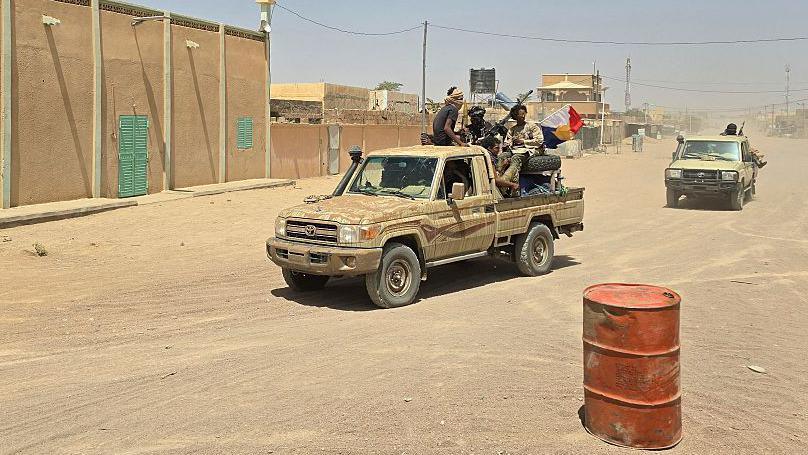
Mali is becoming a geopolitical chessboard—and the latest move has sent shockwaves across the Sahel. The Russia-linked Africa Corps has officially confirmed its withdrawal from Kidal, a strategic northern stronghold long contested by Tuareg rebels, Malian forces, and foreign allies. The pullout follows a surge in violent attacks across northern and central Mali, raising urgent questions about security stability, Russia’s strategic retreat, and the vacuum left in its wake.
This isn’t just a military shift—it’s a recalibration of power in a fragile region where jihadist insurgencies, ethnic tensions, and foreign intervention have pushed the country to the brink.
Confirmed Exit: What the Africa Corps Said About Leaving Kidal
In a rare public statement, a spokesperson for the Russia-aligned Africa Corps confirmed that its forces have "completed operational redeployment" from Kidal. While the announcement avoided the word "withdrawal," the message was clear: Russian-linked troops are no longer maintaining a forward presence in the volatile northern town.
“Our mission in Kidal has transitioned. Units have been repositioned to support broader counterterrorism objectives in coordination with Malian defense authorities,” the statement read.
Analysts interpret this as a strategic retreat. Kidal, located deep in Mali’s desert north, has historically been a flashpoint. Home to the predominantly Tuareg population, it was the epicenter of multiple rebellions and declared autonomy in 2012 before being recaptured by French-led forces in 2013. In recent years, it has remained a symbol of resistance—and a logistical nightmare for any occupying force.
The Africa Corps’ departure suggests that even elite paramilitary units backed by Russian logistics and firepower are struggling to maintain control in the face of relentless attacks and local resistance.
Why Kidal Matters: Geography, Rebellion, and Strategic Value
Kidal isn’t just another town. It’s one of the most remote and geographically challenging regions in West Africa. Situated in Mali’s far northeast, it borders Algeria and Niger, making it a crossroads for smuggling, arms trafficking, and jihadist movement.
But its importance goes beyond terrain. Kidal has long been the cultural and political heartland of the Tuareg people. Their repeated uprisings—in 1963, 1990, 2007, and 2012—were rooted in demands for autonomy, control over resources, and resistance to central Malian authority.
When the Russia Africa Corps moved into Kidal in late 2022, it was seen as a bold assertion of influence—filling the vacuum left by the withdrawal of French forces after a nine-year anti-jihadist campaign. But the occupation faced immediate backlash, including protests and targeted attacks.
Key reasons Kidal is strategically significant:
- Gateway to the Sahara: Controls flow of weapons, migrants, and insurgent groups between North and West Africa.
- Symbol of resistance: Seen by Tuareg factions as a litmus test of sovereignty.
- Resource proximity: Located near potential uranium and gold deposits—valuable for both state and non-state actors.
- Jihadist infiltration: Groups like JNIM (al-Qaeda affiliate) and ISGS (Islamic State in the Greater Sahara) have exploited local tensions to gain footholds.
In this context, the Africa Corps’ departure is less a tactical withdrawal and more a signal of diminishing returns.
Escalating Attacks: The Security Crisis That Forced the Pullout
The decision to leave Kidal didn’t come in isolation. It followed a sharp rise in attacks across Mali, especially in the regions of Ménaka, Gao, and northern Timbuktu. According to ACLED (Armed Conflict Location & Event Data Project), violent incidents in northern Mali increased by 47% in the first half of the year compared to the same period last year.
Recent attacks include:

- Ambush near Abeïbara (April): A joint Malian-Africa Corps patrol was hit by an IED and small arms fire, killing at least 12 soldiers.
- Suicide bombing in Gao (May): A vehicle-borne attack targeted a military checkpoint, killing 8 and injuring 15.
- Raids on supply convoys: Multiple attacks on logistics routes between Gao and Kidal disrupted resupply efforts.
These weren’t isolated incidents. They reflected a coordinated effort by jihadist networks and possibly resurgent Tuareg militias to test the limits of Russian-backed forces.
The Africa Corps, believed to be composed largely of former Wagner Group mercenaries with combat experience in Ukraine, Syria, and the Central African Republic, was brought in to stabilize the region. But even their reputation for brutality and discipline couldn’t neutralize the threat.
Why the attacks worked:
- Familiarity with terrain: Local militant groups know the desert corridors and can launch ambushes with precision.
- Blended insurgent tactics: Use of IEDs, hit-and-run strikes, and sleeper cells undermines static defenses.
- Declining local support: The Africa Corps’ heavy-handed tactics alienated civilians, making intelligence gathering harder.
In essence, the enemy wasn’t just outside the gates—it was already inside, embedded in the community.
The Wagner Legacy: How Russia’s Shadow Army Operates in Africa
The Africa Corps is widely seen as the successor to the Wagner Group, especially after Yevgeny Prigozhin’s failed mutiny in Russia and his subsequent death in a plane crash in August 2023. While officially disbanded, Wagner’s network never truly disappeared—it evolved.
Russia’s Africa strategy relies on deniability. Instead of deploying regular troops, it uses private military companies (PMCs) to train local forces, protect mining assets, and carry out direct combat—without triggering formal diplomatic backlash.
In Mali, Wagner (and now Africa Corps) operates under a bilateral agreement with the military junta that took power in 2021. In exchange for security support, Russia gains:
- Access to gold and uranium mining sites
- Strategic military positioning in the Sahel
- Influence over a key regional player
But the model is fraying.
Reports from human rights groups—including UN investigators—have documented summary executions, torture, and mass killings attributed to Wagner and its successors. In March 2023, a massacre in the village of Niafunké left over 300 civilians dead, with evidence pointing to Russian mercenaries.
Such actions fuel resentment and make long-term stability impossible. The withdrawal from Kidal may be less about defeat and more about damage control—avoiding further reputational harm as the world watches.
What Happens Now? The Power Vacuum and Regional Fallout With Russian forces pulling back from Kidal, the question isn’t just who fills the void—but how quickly.
Three scenarios are now likely:
1. Resurgence of Tuareg-led Armed Groups The Coordination of Azawad Movements (CMA), a coalition of Tuareg militias, has historically controlled Kidal during periods of weak central authority. They may attempt to reassert influence, especially if the Malian army lacks the capacity to move in.
2. Expansion by Jihadist Networks Groups like JNIM and ISGS are poised to exploit any security gap. A return to Kidal would give them a symbolic victory and a base to launch attacks further south.
3. Malian Military Overextension The Malian army, already stretched thin between central Mali’s insurgency and border threats from Burkina Faso and Niger, may struggle to maintain control. Their reliance on Russian air support and intelligence means the Africa Corps’ redeployment could degrade operational effectiveness.
Real-world example: In 2012, when Malian forces fled Kidal during the Tuareg rebellion, it took French intervention to reclaim the city. History suggests that without external backing, holding Kidal is nearly impossible.
The broader regional impact could be severe. Neighboring countries—especially Niger and Burkina Faso, both under military rule and facing their own insurgencies—are watching closely. A collapse in northern Mali could reignite cross-border violence and mass displacement.
Russia’s Calculated Retreat: Strategic or Forced?
Was the withdrawal from Kidal a planned strategy—or a sign of defeat?
Evidence points to both.
On one hand, Russia may be consolidating its forces in more defensible areas like Gao and Bamako, focusing on protecting high-value assets and urban centers. Kidal, while symbolic, is logistically draining and politically costly.
On the other hand, the timing suggests pressure. The increase in attacks, international scrutiny, and internal instability in Mali’s junta—all indicate that Russia’s gamble in the Sahel may not be paying off.
Moreover, Russia’s global military commitments—especially in Ukraine—limit its ability to sustain open-ended operations in Africa. The Africa Corps may simply lack the manpower to hold every contested zone.
Strategic indicators of a long-term shift:
- Increased diplomatic outreach to Algeria and Morocco, suggesting alternative influence routes.
- Reports of Russian personnel rotating out of Mali and into other African states like Burkina Faso and CAR.
- Reduced frequency of Russian airstrikes, indicating scaled-back operational tempo.
This isn’t retreat—it’s realignment.
The Human Cost: Civilians Caught in the Crossfire
Behind every strategic analysis are real people. Thousands of civilians in Kidal and surrounding areas have lived under occupation, rebellion, and constant threat.
Since early 2023, over 60,000 people have been displaced from northern Mali, according to the UNHCR. Schools are closed, markets are shuttered, and medical access is nearly nonexistent.
Local humanitarian workers report a climate of fear. “People don’t know who to trust,” said one aid coordinator in Gao, speaking on condition of anonymity. “One day it’s the army, the next it’s rebels, then Russians. Everyone claims to bring security, but all we see is more violence.”
The withdrawal from Kidal could worsen the crisis. If no credible force moves in, lawlessness will grow. If Malian forces enter with heavy-handed tactics, it could trigger another cycle of revenge and displacement.
What’s Next for Mali—and the Sahel?
The confirmation of Russia’s Africa Corps withdrawal from Kidal marks a turning point. The era of foreign-led stabilization in northern Mali appears to be stalling.
But this isn’t the end of the story—it’s a recalibration. The Malian junta must now decide whether to pursue negotiations with Tuareg leaders, double down on military action, or seek new allies.
For the international community, the message is clear: short-term military fixes don’t resolve deep-rooted political and ethnic tensions. Sustainable peace requires inclusive governance, investment in local institutions, and accountability for abuses—something no foreign mercenary force can deliver.
Mali’s path forward remains uncertain. But one thing is evident: the days of external powers holding Kidal by force are numbered.
FAQ
Why did Russia’s Africa Corps withdraw from Kidal? The withdrawal followed escalating attacks, logistical challenges, and declining local support. The strategic cost of holding Kidal outweighed the benefits.
Is the Africa Corps the same as the Wagner Group? Not officially, but it’s widely seen as Wagner’s successor, using similar personnel, tactics, and command structures under Russian state oversight.
Who controls Kidal now? As of the latest reports, no single group has declared control. The Malian army may attempt to move in, but security remains unstable.
Are jihadist groups gaining ground in Mali? Yes. Groups like JNIM and ISGS have intensified attacks in the north and center, exploiting security vacuums and local grievances.
How has the local population reacted to the withdrawal? Mixed reactions. Some welcome the departure of foreign forces accused of abuses; others fear renewed violence or militia rule.
Could Tuareg rebels retake Kidal? It’s possible. The CMA has historical ties to the region and may seek to reestablish autonomy if the Malian state doesn’t assert control.
What does this mean for regional stability? High risk. A power vacuum in Kidal could trigger cross-border spillover, affecting Niger, Algeria, and Burkina Faso.
FAQ
What should you look for in Russia’s Africa Corps Confirms Withdrawal from Kidal Amid Mali Attacks? Focus on relevance, practical value, and how well the solution matches real user intent.
Is Russia’s Africa Corps Confirms Withdrawal from Kidal Amid Mali Attacks suitable for beginners? That depends on the workflow, but a clear step-by-step approach usually makes it easier to start.
How do you compare options around Russia’s Africa Corps Confirms Withdrawal from Kidal Amid Mali Attacks? Compare features, trust signals, limitations, pricing, and ease of implementation.
What mistakes should you avoid? Avoid generic choices, weak validation, and decisions based only on marketing claims.
What is the next best step? Shortlist the most relevant options, validate them quickly, and refine from real-world results.